

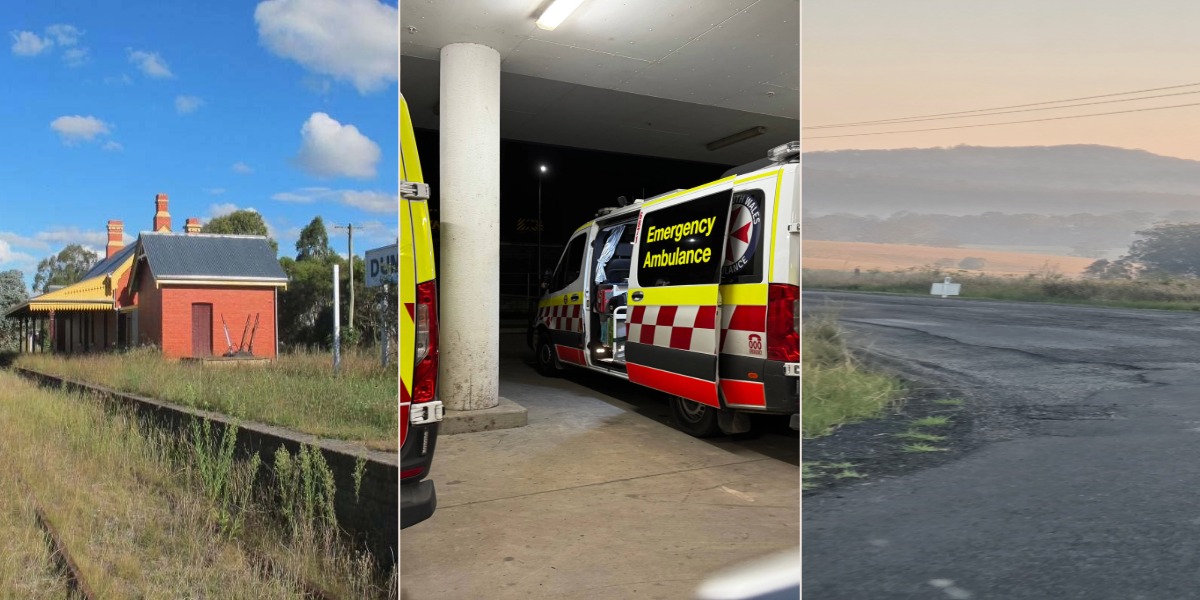
We hear lots and lots of stories here at New England Times… but not all of them we can publish.
Whether it’s because lawyers say no, or we can’t get three sources to corroborate the story, or we can’t get people to go on record, there’s lots of stuff we’d love to tell you but just can’t.
Here’s three of the biggest stories of 2025 that we couldn’t tell you.
$400,000 for something that doesn’t exist
Just when you think the one-eyed determination of some in Armidale Regional Council to push ahead with the dead horse of the New England Rail Trail couldn’t get any stranger, comes one line in a NSW Government press release that indicated a dodgy – or delusional – deal may have been done.
In their celebratory announcement that the Armidale BESS had been approved was this:
“Valent has committed to annual contributions totalling $400,000 for the upkeep and enhancement of the New England Rail Trail over 20 years.”
In the convoluted world that is REZ developments, the energy companies must have negotiated an agreement with affected local councils to return some of the wealth of the development back to the community. The state government approves the developments, not councils, and they don’t seem to care much what is in the Voluntary Planning Agreement (or VPA) – only that there is one.
Neither Valent or the NSW Government, nor the politicians quoted in the press release, would answer questions about why there was a commitment to the Rail Trail – a private company proposing a development that currently does not meet the NSW Government’s framework, lacks widespread community support, and will not be approved until current wholesale reviews of rail infrastructure are complete – in the VPA.
No one wanted to tell us what happens to the $400,000 should the beleaguered Rail Trail proposal not go ahead. We couldn’t even get clarification on whether it was $400,000 per year for 20 years, or $400,000 spread out over 20 years.
Armidale Regional Council answered the query, but wanted to know what the angle would be before they would provide an answer to our questions. We tried to explain that is not how journalism works…
Patient transfers to nowhere
Following (my personal experience of being transferred from Armidale to Tamworth hospital and being told to make my own way home, and) some horrifying stories coming from places like Wee Waa, Moree, Bingara and Inverell that lots of people were being sent very long distances to bigger hospitals for very basic care – and even things as basic as needing an Xray or having a baby – we tried really, really, really hard to do a story on this aspect of our broken health care system. We did everything we could to find out how many patients were being transferred from hospitals in our region to other hospitals, how many were being kicked out the door and stranded a long way from home, and how much all of this patient movement was costing the taxpayer.
We tried multiple angles of inquiry – Hunter New England Health, NSW Health, Minister for Health – and eventually a GIPA (freedom of information) request to get the information, and got absolutely nowhere.
Questions asked of NSW Health under GIPA and not answered
1. Please supply information on the numbers of patients in the financial year 24/25 who were:
a) transferred from the hospital or health service they presented at in the New England region to another facility in the NSW or Queensland health system that was in a different town or locality broken down by origin and destination (for example: transferred from Inverell to Armidale is x number; Inverell to Tamworth is y; Inverell to John Hunter is z);
b) the mode of transport (rescue helicopter/plane, ambulance, patient transfer, private or other type of transport);
c) the reason for transfer (medical need – such as specialist care or surgery; system need – such as lack of beds; patient choice or other);
d) the mode of transport back to their hometown or locality
2. If not already covered in the response to question 1(a) please provide:
a) the total number of patients discharged from a hospital other than their original admission; and
b) number of patients who were, or were not, assisted with post-discharge travel to their town.
3. The average cost per patient for each mode of transport (perhaps by kilometre)
4. Copies of policy documents or instructional staff guides on patient transfers current or issued during that time.
NSW Health bumped the GIPA request to Hunter New England Health, who replied about a month later asserting the data does not exist.
We were given a copy of the patient transfer policy and process documents, which are completely inappropriate for our circumstances – with the only need for transfer considered being access to specialist and critical care, and are silent on the issue of transferring patients to another town. The discharge process policy we looked up ourselves considers the need for organising patient transfers on discharge, but again is silent to when that is to a different town.
HNE Health conceded that every patient transfer is tracked centrally by what is called the patient flow system, but denied that there are any reports produced from the patient flow system.
They said there was one report relating to cost of patient transfers, but because it was from the financial year prior to our inquiry, they refused to provide it. NSW Health Media didn’t give it up either.
We may come back to this story in 2026, and have been in touch with politicians about using the tools of parliament to find out just how much NSW Health would rather ship us elsewhere than provide a basic standard of care in the New England.
New roads falling apart
One of the questions we never really got a satisfactory answer too on multiple occasions is why recently repaired roads were falling apart faster than old ones.
There were a number of reports of this when we did that big story on the New England Highway falling apart after they closed the Pacific Highway. Transport for NSW always had a story or an excuse – or just flat out denied that was the case.
One of those roads was Paddy’s Flat Road at Tabulum. It had a significant upgrade early in the year, announced with much fanfare and even a video of the difference it would make to people in the area.
That work was completed in February 2025, but by September, after TC Alfred and multiple other significant rain events, the road was trashed.
Jo, a local who regularly uses the road to get to work, got in touch and provided us with a heap of photos of the state of the road – but, contrary to the assertions of others about the rain, she said that they were needing to do patchwork and repairs before they completed the road in February, and before TC Alfred.


Transport for NSW would not give a statement but on background threw Council under the bus and said this (significant road that they were happy to take credit for) was not their problem, talk to Council.
Tenterfield Mayor Bronwyn Petrie said “Council is investigating the Paddys Flat Rd condition failure (and especially in such a short time frame of the initial work being done) to get the facts on the cause.”
We had to set this one aside as we simply couldn’t get to the bottom of it to be able to tell it.
Got a story you think we should get into in 2026? Email newsdesk@netimes.com.au or we have a news tip form if you find that easier.
Got something you want to say about this story? Have your say on our opinion and comment hub, New England Times Engage