

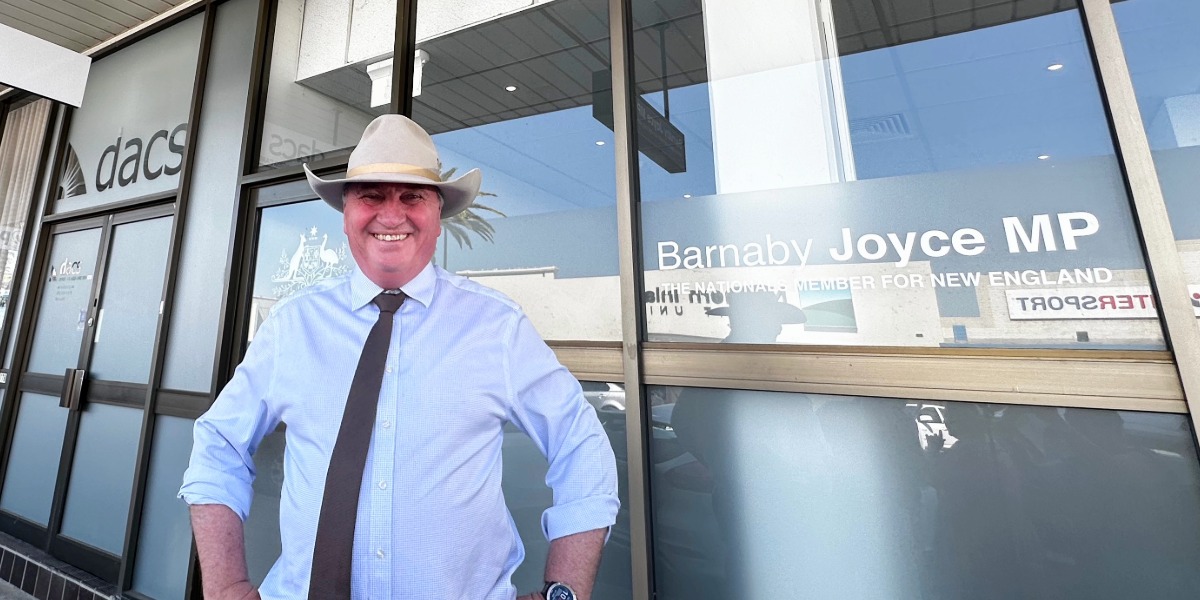
Member for New England Barnaby Joyce says he will step away from politics in the New England at the next federal election, ending a 15-year run in the region, a decision he said was about finishing on his own terms.
In a passionate media doorstop in Tamworth today, October 21, the former Deputy Prime Minister and Nationals leader confirmed he would not recontest the seat, but would continue to serve the remainder of his term.
“My love, my affection, and my service for the people of New England continues,” he said.
“It’s been an incredible honour to represent this area for what will be, at the end of this term, 15 years. That’s a pretty good run. And when that time comes, I want to conclude on my terms.”
Despite stepping back, Joyce said his commitment to New England and regional Australia remained unwavering.
“I’m not leaving because the passion’s gone; I’m leaving so I can do it the right way,” he said.
“I don’t want to be the discordant note. I don’t want to be Grumpy Barnaby. That’s not who I am.”
Mr Joyce said his relationship with the National Party leadership had “broken down”, likening the situation to a marriage that had run its course.
“If someone says, ‘We need generational change,’ and, ‘I don’t want to be seen with you in public,’ well, that’s not looking good,” he said.
“You reach a point where you quietly go your separate directions. No throwing plates around the kitchen. No demeaning behaviour. Just an honest recognition that it’s time.”
He said his decision to resign from standing again came after what he described as a “traumatic” period, with rumours about defecting to One Nation surfacing just as he was preparing to speak at an LNP party function in Queensland.
“That was the straw that broke the camel’s back,” he said.
“I thought, ‘okay, I’ve arrived there. That’s it. Time to deal with it and move on’.”
Mr Joyce said he had spoken with Nationals leader David Littleproud and deputy Sussan Ley, describing the conversations as “polite and respectful”.
“Susan’s a very good person, we just have different philosophical views,” he said.
“I want to make it clear this isn’t an attack on her or anyone else. This is about direction, not personalities.”
He criticised the Coalition’s direction in appeasing teal seats in the cities, which, he argued, came at the expense of working people in the regions, and said the National Party had forgotten the people they once championed.
“When I walk down the street, people don’t care about the teals,” Mr Joyce said.
“They care about whether they can pay their power bill, or whether their property is about to be covered in transmission lines. That’s who we’re supposed to fight for.”
Mr Joyce said his stance against net zero emissions targets remained unchanged, calling them “no good” for rural and regional Australians.
“I see farmers whose land is being swallowed up by industrial wind and solar projects,” he said.
“I meet families who can’t afford to keep the lights on. That’s not progress, that’s pain.”
He welcomed signs that the Coalition was reconsidering its position on net zero, saying “authentic change” was needed.
“If they’re really moving away from net zero, good,” he said.
“But it has to be real. Not some tricky halfway thing. We need to be authentic to Tamworth, to Nundle, to Weabonga, to every place dealing with this.”
With speculation rife about a move to Pauline Hanson’s One Nation party, Mr Joyce has not confirmed any future plans.
“Let’s not go too far ahead,” he said.
“I’m still a member of the National Party. I haven’t joined another party. But it’s no secret that there are issues Pauline and I see similarly, particularly around property rights, sovereignty, and a fair go for farmers.”
Reflecting on his time in parliament, Mr Joyce said he was proud of what had been achieved for the New England region from infrastructure and health projects to telecommunications and university funding.
“You can drive around the electorate and see the results,” he said.
“The Muswellbrook and Scone bypasses, upgrades at the University of New England, Indigenous health services, local sports grounds, mobile towers, these are things I fought for.”
“It’s not about me. It’s about what we did together to make this place better.”
He said he would devote the remaining years of his term to regional issues, particularly water storage, medical access, and supporting local industry.
“We still can’t get doctors into the region. Don’t worry about Doctors Without Borders, we’ve got hospitals without doctors,” he said.
Mr Joyce said we needed further water security to attract industry to the region and he said he wanted to look after the farmers, particularly in relation to vegetation laws, get infrastructure to the region and investment in the University of New England.
He said he also wanted to let the miners do their jobs in the Hunter region and had lobbied for a nuclear power plant down there and push for the Tenterfield bypass.
Mr Joyce said announcing his decision two and a half years ahead of the next federal election would give the Nationals time to find the right successor.
“I want to give the New England a good chance of casting your eye over people,” he said.
“What I think is a huge problem with elections is that, often, people don’t find out who’s running until six weeks to go, and you don’t know these people from a bar of soap and you’ve got to make decisions about them.”
Mr Joyce said it was up to the people of New England who would replace him, but he said that he would be “disappointed if this became a teal-type seat”.
He said the region needed a Member who understood the regions, our values, our challenges and priorities.
As for his own future, Mr Joyce said he would continue to “fight for change” but would not rush to decide on future plans.
“I’ve still got two and a half years left to serve, and I’ll do that to the best of my ability,” he said.
“I work with the parliament as best I can. I have a lot of dear friends in The Nationals, I don’t want enemies. I want to work in such a fashion that I get results here.”
However, Mr Joyce would not guarantee that he would remain a member of the National Party for the remainder of his time and, if he left the Nationals prior to the next Federal Election, what affect that would have or what that would look like.
“I’m a free agent, I don’t make any guarantees there… you’ve got to be really careful to see how things transpire and then you make decisions as things go along,” he said.
“The vast majority of the work is done in this office. I don’t want to start salami slicing in and out because in the end you completely lose all your cards and you don’t do that in politics; you always keep your cards up your sleeve because that allows you to get things for your people.”
Got something you want to say about this story? Have your say on our opinion and comment hub, New England Times Engage