

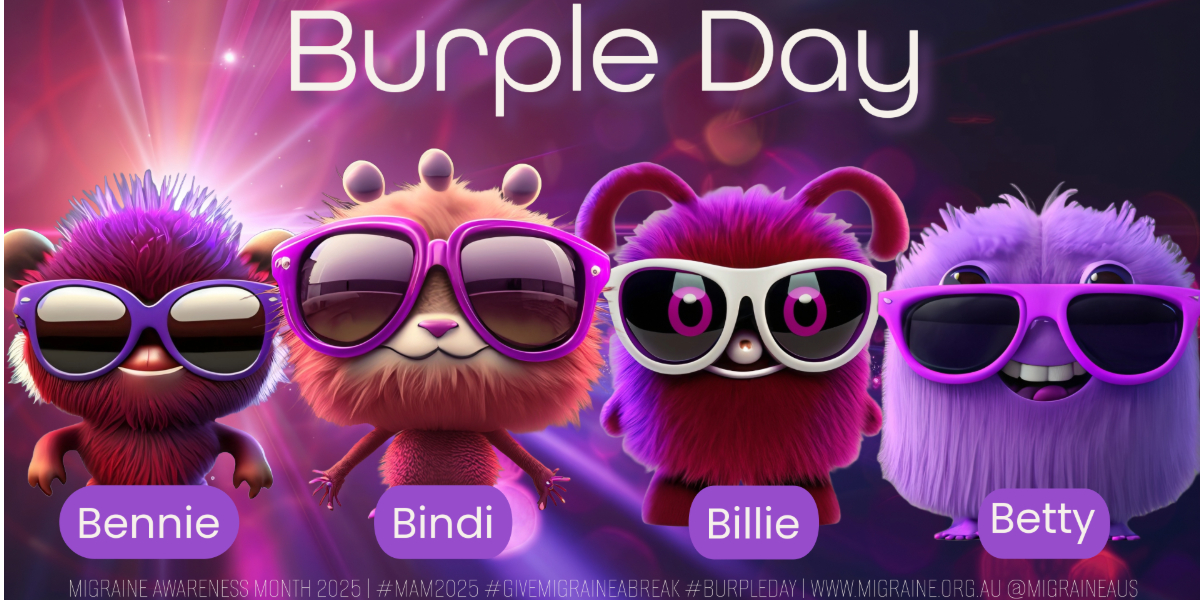
Australians across the country are donning burgundy and purple today for Burple Day, the flagship event of Migraine Awareness Month, aimed at shining a light on one of the nation’s most misunderstood and underfunded health conditions.
With nearly five million Australians affected, migraine is far from “just a headache.” It is a disabling, complex neurological disorder that significantly impacts lives, yet remains poorly understood and heavily stigmatised.
“1 in 5 Australians lives with some form of migraine, yet most don’t truly understand it,” said Jude Kingston, Chair of Migraine Australia.
“They’ve been told it’s their fault, that it’s something they ate or didn’t do. But migraine is nobody’s fault—and it certainly isn’t ‘just a headache’.”
Burple Day encourages people to wear the international colours of migraine awareness—burgundy and purple—as a sign of solidarity and support.
Migraine Australia, the country’s only patient organisation for migraine, is calling for greater awareness, improved access to care, and an end to the social stigma that continues to surround migraine. The organisation says people living with migraine are often dismissed by healthcare professionals, misunderstood at work, and even doubted by those closest to them.
“Real change starts with real connection,” said Kingston.
“People with migraine often don’t get the help they need until they find others who understand. Peer support is the gateway to proper care.”
The science around migraine has changed dramatically in recent years. Once thought to be a vascular issue, migraine is now recognised as a complex, genetic, sensory processing disorder that causes the brain to be hyper-reactive. This evolving understanding has led to the development of new CGRP-based treatments that are helping people regain control of their lives, as well as significant improvement in management of the life long condition.
However, the organisation warns that access to these new treatments remains limited, and many Australians continue to face long delays in diagnosis, poor treatment options, and a lack of support.
While the science of migraine has advanced, most of the systems around it—healthcare, policy, and public understanding—have not kept pace.
The economic impact of migraine is also considerable. A report by Deloitte Access Economics found that migraine costs the Australian economy $35.7 billion annually through lost productivity, healthcare costs and welfare dependency. The advocacy group says that with proper investment, those figures could be significantly reduced. Effective treatment and support could enable hundreds of thousands of Australians to return to work, reduce both absenteeism and presenteeism, and ease the burden on the health and welfare systems.
“The opportunity of the migraine revolution is as big as the scale of the problem,” Kingston said.
Throughout June, Migraine Australia is encouraging participation in awareness activities, including Shades for Migraine Day on 21 June, and joining Migraine Warrior Support Groups on Facebook, including the local New England group, to find peer support and community.
Whether affected personally or supporting someone who is, Australians are encouraged to wear their colours, share their stories and help #GiveMigraineaBreak.
More information is available at https://www.migraine.org.au/mam2025.
Something going on in your part of the New England people should know about? Let us know by emailing newsdesk@netimes.com.au