

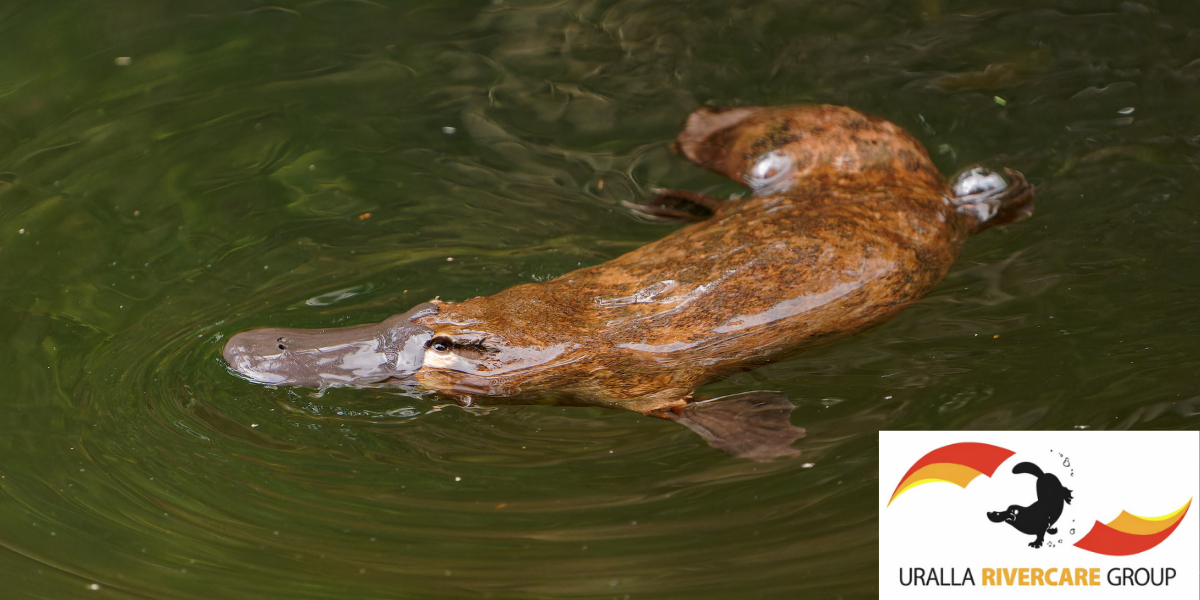
There’s a quiet sense of excitement building along Uralla Creek, with recent sightings suggesting one of Australia’s most iconic native animals may be making a long-awaited return.
Uralla Rivercare Group, first established in 2000, has long held the hope of seeing platypuses back in local waters. Now, after years of restoration work and a renewed wave of community energy, that hope is beginning to look like reality.
Jason Pickersgill is one of the dedicated volunteers behind Uralla Rivercare Group’s revival.
“The Uralla Rivercare group has been running since 2000,” he said.
“They did really, really good work, but unfortunately, their membership, as happens with community groups, the average age got older and the momentum was lost.”
By around 2015, activity had slowed. What exists today is something of a revival.
“This is essentially a redux of the group that we’re doing now,” he said.
“So some new people in town, some people have been here for quite some time, but a little bit younger, energetic, interested in conservation and platypus and rakali and that sort of thing.”
In recent months, platypuses have been spotted along different stretches of the creek. While these are not yet scientifically verified sightings, they are promising.
“There have been a few sightings of platypus along the creek in different parts of the creek,” Jason said. “Not research-based sightings, which is a threshold we would like to cross, which will require some verified imagery.”
To confirm their return, the group hopes to secure high-quality time-lapse cameras.
“We’re endeavouring to beg, borrow, or steal some high-quality timelapse cameras so that we can put them in place and then come back and check on them every now and then,” he said.
Historically, platypuses were far more common in the system. Official records show only “a scattering” of scientifically recognised sightings in recent decades, “once every decade or so,” Jason said, but anecdotal evidence suggests they were once abundant.
While platypuses can tolerate a range of environmental conditions, their survival depends on one crucial factor.
“They are dependent on the invertebrates in the water,” he explained. “And that’s something that we’re going to be focusing on, is surveying what the population of invertebrates is in the river, to work out which parts of the creek are actually able to sustain platypus. Because obviously if there’s no food, there’s no platypus.”
The same principle applies to another native species the group is keen to see thriving again – the rakali, also known as the Australian water rat.
“We’re very interested in the rakali. Obviously, cute furry animals are easier to highlight to the general public,” Jason said.
Rakali, sometimes affectionately dubbed the “Australian otter”, are semi-aquatic mammals with a broader diet than the platypus, feeding on both invertebrates and vegetative matter.
“It’s quite similar in many respects. A broader diet … but also dependent on invertebrates,” Jason explained. “So hopefully if we can find one, we can find the other.”
Improving the creek’s overall health is central to both species’ survival. The group plans to undertake water testing to establish a baseline for water quality and monitor changes over time.
“We’re looking to do some water testing to set up baseline for the quality of the water in the creek at the moment. And then we can monitor that over time,” he said.
For Jason and his wife, joining the Rivercare Group was a natural extension of their environmental interests.
“It’s a beautiful creek, but like all creek systems in Australia, it’s been badly treated historically,” he said. “And so our goal, I guess, is to ensure that the creek doesn’t just become a stormwater drain, which so often happens.”
The group is also working toward improving pedestrian access in a way that balances human use with habitat protection.
“We’d like to make it more accessible, particularly to pedestrians, but keeping that in line with an ecological approach as well,” Jason said.
“So it’s not just for humans, but also for the animals that live here.”
Community involvement will be key in confirming sightings and building momentum.
“If people to see a platypus if they could contact us, that would be great. At least at a minimum we can accrue some anecdotal evidence. If they can get a photo and a geolocation, even better,” he said.
“But you know, not everyone’s walking around with a telephoto lens all the time.”
The group is also actively recruiting new members.
“Absolutely, yes … absolutely, anyone.”
For those lucky enough to glimpse one, whether platypus or rakali, the experience is unforgettable.
“They really are magical,” Jason said of the platypus.
With renewed energy, scientific plans underway, and a community watching closely, Uralla Creek may soon again be home to both platypus and rakali, living proof that careful restoration can bring wildlife back to where it belongs.
Something going on in your part of the New England people should know about? Let us know by emailing newsdesk@netimes.com.au