

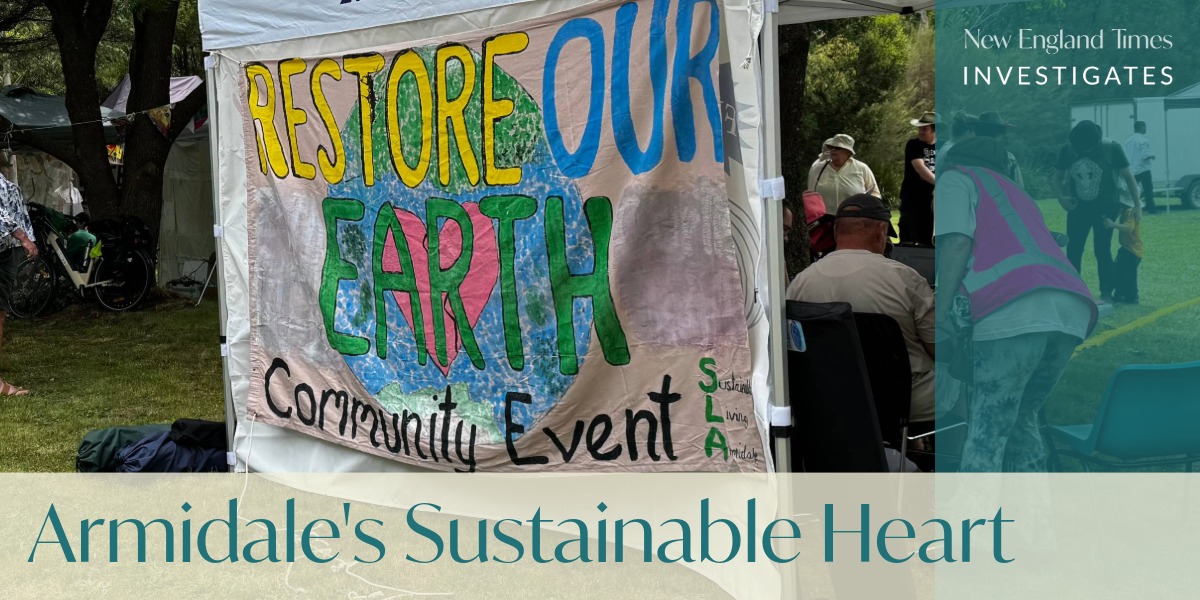
New England is often portrayed as an “anti-net zero” heartland – derided for being sceptical of climate action and resistant to change.
While the electorate has historically leaned conservative, the extreme “anti-net zero” framing is recent and driven by national media. The reality is far more complex and a much longer story.
In part one of our New England Times investigation by Emily Longhurst, we look at how environmental sustainability has been part of the culture in Armidale for at least half a century.

New England is often framed in national debate as an “anti-net zero” heartland: socially conservative, sceptical of climate action, and resistant to change. It is a shorthand reinforced by recent political headlines and popular media narratives. Yet in Armidale, this characterisation sits uneasily alongside a much longer, richer, local history.
For more than half a century, local residents have been actively engaged in environmental protection, renewable energy, and community-led sustainability. Long before the term “sustainable living” entered everyday language, people in Armidale were experimenting, organising, and advocating for practical ways to care for land, resources, and community wellbeing.
Sustainable Living Armidale (SLA) is a volunteer-run, community-based organisation that supports practical responses to climate change, resource limits, and environmental degradation. Since forming in 2007, it has focused on education, participation, and local action, creating spaces for people to learn, share skills, and work together on issues ranging from energy and food systems to biodiversity, social justice, and community resilience. Rather than campaigning from the sidelines, SLA has acted as a connector, bringing together individuals, organisations, and ideas to turn concern into constructive, place-based action.
Founding Sustainable Living Armidale member Bar Finch has lived and worked in Armidale for decades and describes sustainability as something the community practised long before it had a name.
“It only got the name ‘sustainable living’ when SLA started in 2007,” Finch said. “But there were a lot of community organisations concerned with environmental issues well before that.”
Environmental activism in the city can be traced back to the early 1970s. The Armidale National Parks Association, founded in 1974, continues to connect environmental groups across the region. Around the same time, a Solar Energy Society based at the University of New England hosted public talks, workshops, and demonstrations, introducing early renewable energy ideas to the wider community.
That same year, Armidale hosted an Alternative Technology Festival, a modest but forward-thinking weekend event exploring how innovation could support social and environmental change.
“The language then wasn’t ‘sustainability’,” Finch said.
“What you heard was ‘alternative technology’ or ‘counterculture’, all springing from an awareness that the way society was organised wasn’t serving either the planet or humanity.”
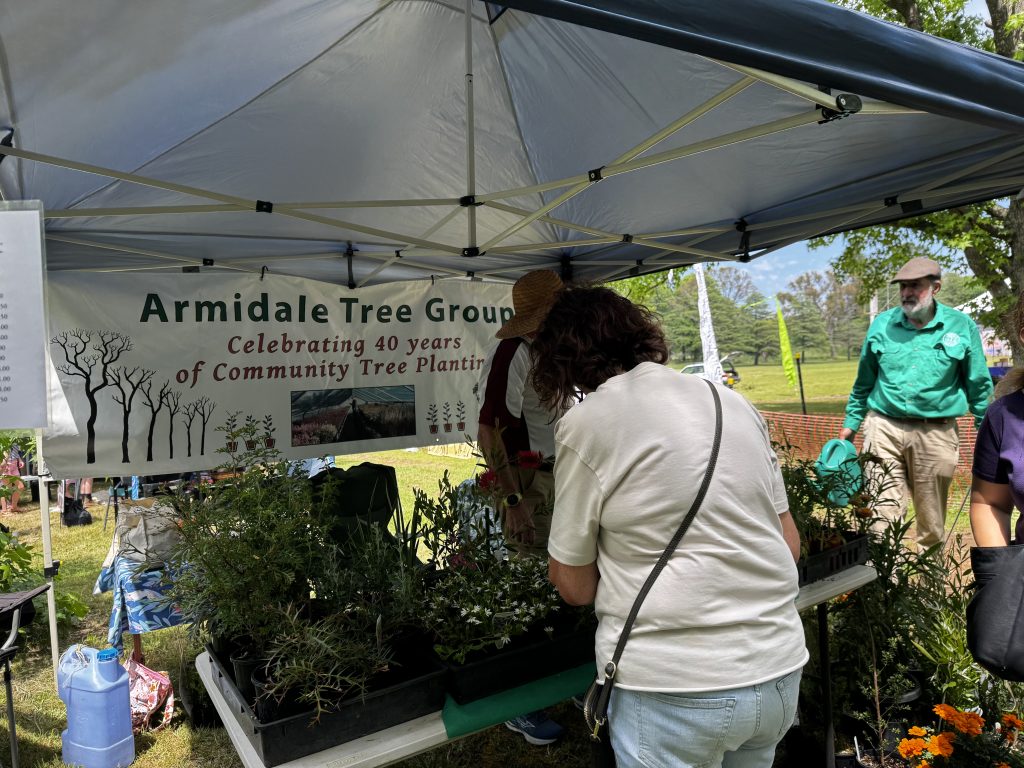
The movement deepened through the 1980s and 1990s. The Armidale Tree Group formed in 1983 in response to widespread eucalyptus dieback and became a powerful force for local environmental action. Landcare groups spread across the district, embedding soil health, biodiversity, and water management into everyday farming and land stewardship. Renewable energy businesses, including (local Armidale Regional councillor and former independent candidate for New England) Rob Taber’s business New England Solarpower, were established well before solar power became mainstream.
Local government also played a formative role. In 1988, Armidale City Council appointed Steve Gow as Town Planner, introducing initiatives such as insulation retrofitting subsidies, sustainable subdivision planning, and stronger council support for community environmental projects, reforms that shaped the city for decades.
Local politics reflected this pragmatism. Independent MP Tony Windsor represented the federal seat of New England from 2001 to 2013. With a farming background and a strong focus on land stewardship and conservation, he was repeatedly re-elected with large margins, demonstrating that conservatism in the region has not automatically translated into climate denial.
It was within this long history of local action that Sustainable Living Armidale (SLA) emerged in 2007, following community workshops on climate change, peak oil and resource limits. Inspired by the global Transition Towns movement, SLA did not invent concern for sustainability; it gave it a name, a structure, and a public voice.
SLA founding member Patsy Asch said the urgency and creativity were inseparable.
“SLA grew out of concern about peak oil, climate change, and government denial, but it quickly became an energetic, creative outpouring of community action focused on protecting the environment, social justice, and the future of our children and grandchildren,” she said.
For Asch, the emergence of Sustainable Living Armidale was not a beginning, but a convergence, a moment when long-standing concern, scientific evidence, and frustration with political inaction came together.
“While I’d been concerned about the environment for a long time, the first climate activity I was actively involved in here was a Walk Against Warming in 2005,” Asch said.
“By 2007, concern about peak oil, climate change, and government complacency had reached a tipping point.”
In Armidale, sustainable living has never been a political slogan. It has grown steadily over decades, shaped by community action, practical solutions, and a deep commitment to place.
Finch says environmental concern has always been part of Armidale life.
“The idea of New England as an ‘anti-net zero heartland’ is a recent media construction that ignores decades of environmental action, community organising, and electoral support for conservation and climate awareness.”
This is part of an investigative series about the sustainable living movement in Armidale. Read the series.
Like what you’re reading? Support New England Times by making a small contribution today and help us keep delivering local news paywall-free. Donate now