

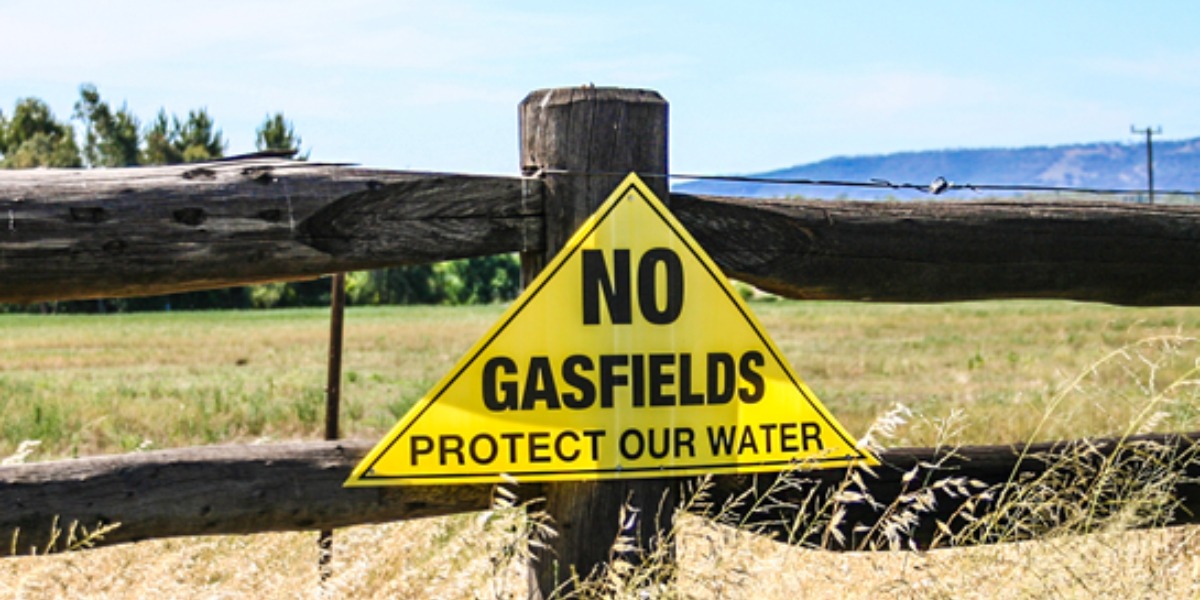
NSW Farmers new acting CEO has escalated the campaign against the Narrabri Gas Project, engaging senior legal counsel and claiming the project involves fracking.
NSW Farmers Acting CEO Mike Guerin said the organisation is “getting the band back together”, bringing in the same legal team that successfully challenged the Australian Government and Glencore over a carbon capture and storage project in the Federal Court last year.
“NSW Farmers has engaged the same senior legal counsel we used to defeat the federal government and Glencore a couple of years ago, and we are actively exploring the best way to defend Australia’s precious groundwater from mining giants,” Mr Guerin said.
He said farming communities reliant on the Great Artesian Basin were “living in fear” that the Narrabri project could cause irreversible harm.
“The people who depend on the Great Artesian Basin for their water are living in fear that this project will go ahead and go wrong, like many of them do, creating tens of thousands of water refugees and forcing farmers to abandon half the continent because it’s been contaminated forever,” he said.
“I’m happy to be getting the band back together on this one, because the risks with the Narrabri Gas Project are simply far too great to let it proceed.”
Mr Guerin, who led AgForce in 2024 when it defeated the federal government and Glencore over a plan to inject carbon dioxide into the basin, said that case had been a watershed moment for groundwater protection. At the time, the court accepted expert evidence warning of high risks of arsenic and lead contamination.
“It’s a sad reality that governments, politicians and mining giants seem to be deaf to these genuine and real concerns about protecting this critical water source,” he said.
“They don’t appear to care about the environment or the communities that will be impacted or the billions of dollars’ worth of food that won’t be grown because of contamination.
“This is why organisations like NSW Farmers are here, to hold decision makers to account and make them do the right thing.”
Mr Guerin said the legal team had recently briefed the NSW Farmers Board, but refused to answer questions about how much the organisation was spending or who had authorised the legal action.
He also claimed that public debate around domestic gas supply was clouded by misconception, while engaging in his own misinformation about the Narrabri Gas Project.
“There are common misconceptions that Narrabri gas is needed to improve the domestic gas supply, and that improving the domestic gas supply will reduce energy prices,” he said.
The Narrabri Gas Project is expected to supply half the state’s gas needs, with 100% of gas produced committed to the domestic market, and the state expected to face gas shortages by 2027 if the project does not proceed.
Guerin also claimed that coal seam gas extraction at Narrabri carries a risk of aquifer contamination because the project involves fracking.
“The CSG process involves injecting fracking fluid and then dewatering the aquifer to extract the gas,” he said.
“This means the Narrabri Gas Project presents 850 opportunities for something to go wrong and contaminate the aquifer, thus contaminating the Great Artesian Basin and its connected aquifers.”
However, despite Guerin’s assertions, the Narrabri Gas Project plans do not involve fracking.
Hydraulic fracturing, more commonly known as fracking, is used to increase the flow of gas and increase the productivity of the wells when production is less than optimal. It is understood fracking is not needed at Narrabri because of an abundance of naturally occurring fractures in the coal seam, and Santos’ plans to use lateral drilling rather than traditional vertical wells. Santos’ factsheet on the planned drilling states “current information on the geology of the coal seams in the Project area indicates gas flow would not be improved by the use of [fracking]”.
The risk of groundwater contamination from coal seam gas drilling is significantly lower than from fracking or carbon capture and storage. NSW Farmers did not explain why they were talking about fracking and carbon capture and storage in relation to their opposition to the Narrabri Gas Project, nor answer questions about whether they were being intentionally alarmist in linking fracking and carbon capture and storage with the planned Narrabri development.
The project has already withstood numerous legal challenges over more than a decade, and this week survived another which specifically referenced water contamination. The Federal Court dismissed a case brought by the Mullaley Gas and Pipeline Accord, which had sought a judicial review of the government’s decision not to apply the water trigger to a new 60-kilometre pipeline associated with the project.
The pipeline will connect the Narrabri Gas Project to the Hunter Gas Pipeline across farmland, the Pilliga Forest and public land, prompting local fears about impacts on the Namoi River and Murray–Darling Basin.
Farmers argued the pipeline was “integral” to gas extraction and should therefore trigger extra scrutiny of water impacts. But Justice Tom Thawley ruled the government’s delegate had applied the law correctly.
“In reaching that conclusion, the delegate was addressing the correct … provisions,” he said.
Environmental Justice Australia, which backed the community group, said the ruling exposed gaps in national environment laws.
“National environment laws are supposed to protect water resources from coal seam gas developments – but today’s ruling shows those protections won’t apply to this pipeline,” lawyer Virginia Trescowthick said.
“Our client is deeply concerned this coal seam gas project can be sliced and diced to avoid proper scrutiny.”
The Narrabri Gas Project received state planning approval in 2020 for up to 850 wells across 95,000 hectares, part of a $3.6 billion development. In May, the Native Title Tribunal approved the granting of land leases, finding significant public interest in the project if gas is supplied to the domestic market, leaving only court cases stopping the project from proceeding. Last month, Premier Chris Minns came out strongly in support of the project, saying the NSW Government would consider compulsory acquisition of property and other necessary actions to ensure the project goes ahead.
Santos Managing Director and Chief Executive Officer Kevin Gallagher said there is overwhelming demand for Narrabri gas and Santos is looking to execute foundation contracts as soon as possible to support development once regulatory and native title processes are concluded. The already have a number of MOUs in place, including one to supply Narrabri Shire Council with cheaper gas for local electricity production.
“Narrabri gas will be a very competitive source of domestic gas supply for the east coast market,” Mr Gallagher said.
“This is a strategic project for NSW that now needs Santos, along with state and federal governments putting our shoulders to the wheel and working together to make it happen.”
Got something you want to say about this story? Have your say on our opinion and comment hub, New England Times Engage