

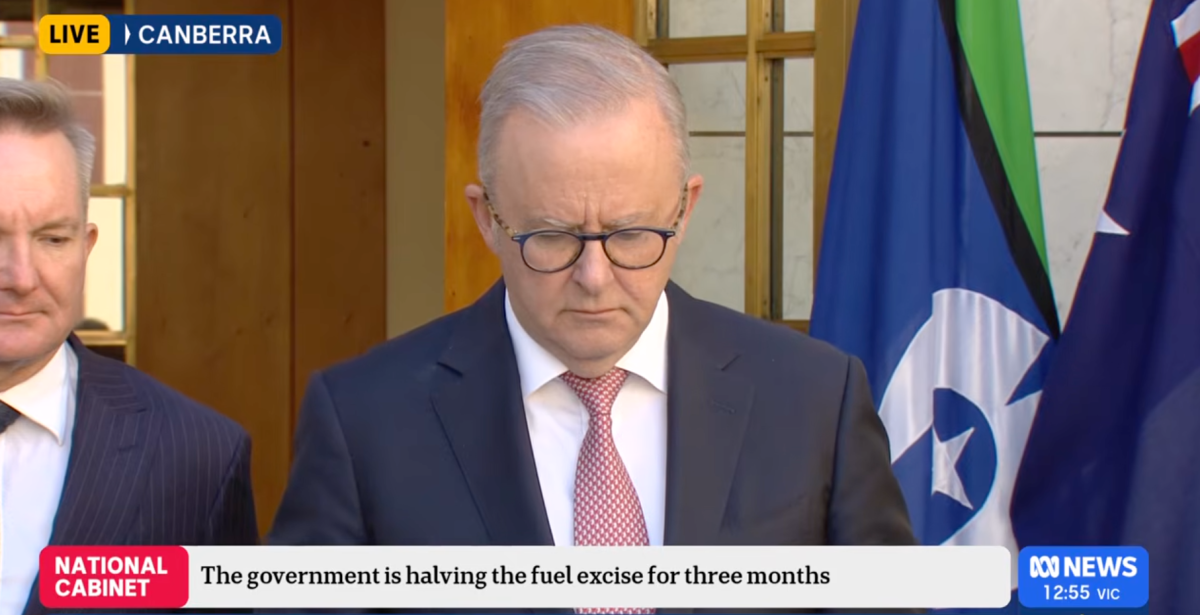
Prime Minister Anthony Albanese has announced that as a result of today’s National Cabinet meeting, fuel excise will be halved for three months and the heavy vehicle user charge will be zeroed for three month to provide immediate relief.
The decision comes just days after Treasurer Jim Chalmers said such a cut to fuel excise was not under consideration, despite strong calls for the measure from both industry and the Opposition, highlighting the rapidly evolving nature of the crisis and the pressure on the government to act.
The Prime Minister said the move was designed to provide immediate cost-of-living relief while ensuring the benefits flow through to consumers.
“Halving the fuel excise will reduce the cost of fuel by 26.3 cents per litre,” he said.
“Importantly, in addition, states and territories have agreed and are finalising a proposal to ensure they won’t benefit from the elevated prices that are occurring because of the GST.”
He said the National Cabinet process was critical to coordinating that outcome across jurisdictions.
“The less fuel we use in the cities, obviously, the more we can direct to regional areas that are under pressure.”
Trucking sector relief as user charges suspended
Alongside the excise cut, the government will also reduce the heavy vehicle road user charge to zero for three months and delay the next scheduled increase by six months.
The Prime Minister said the measure would provide targeted relief to the freight sector, which has been particularly exposed to rising diesel costs and supply uncertainty.
“For many trucking companies that are small, they rely upon a cash flow which is under pressure, because they pay for their fuel and then they get paid down the track in 30, 60, or 90 days, depending upon the contractual arrangements that they have,” he said.
“This is about taking pressure off them.”
Mr Chalmers said the combined measures would cost an estimated $2.55 billion, with an additional $53 million in foregone revenue from delaying the road user charge increase, and will come into effect from Wednesday.
“The steps that we are announcing today are all about taking some of the sting out of these higher petrol and diesel prices for people who are under pressure,” he said.
“This is timely. This is targeted. This is responsible, cost-of-living relief to help people get through a difficult period.”
“We had regional and rural people front of mind in these decisions.”
Stabilising supply measures and economic risks
National Cabinet also reinforced its focus on maintaining supply, including backing private companies to secure fuel shipments from overseas and ensuring domestic production remains onshore.
Speaking this morning on Sunrise, Social Services Minister Tanya Plibersek said the government had already taken steps to stabilise supply.
“So far, when it comes to fuel, we’ve already released 20 per cent of our national stockpile, we’ve prioritised delivery to regional areas, we’ve made sure that the ACCC has extra powers to prevent price gouging, we’ve changed our fuel standards, we’re keeping all of our Australian fuel here onshore,” she said.
“The two refineries that are still going, we’re making sure that all of that fuel stays here in Australia.”
She said new legislation would support companies to purchase fuel on international markets, even at elevated prices.
“We understand that this is a really worrying time for people, that the prices are very high, that they’re really impacting the family budget. We’re happy to do whatever we sensibly can to help with that.”
However, the measures have drawn criticism from some quarters over their fiscal impact.
Speaking this morning on Sunrise, One Nation MP Barnaby Joyce said cutting the excise without offsets would increase government borrowing.
“I think the really important thing is there that you realise when you cut excise, unless you find the offsets, that’s where you’re saving money. You’re just borrowing more money from overseas, and that ultimately has to come back and be repaid,” he said.
Mr Joyce said support for the excise cut needed to be matched with broader structural changes.
“So, we support cutting the excise as long as you do two things. Take into account the road user charge that the heavy industry- that semi-trailers use, that’s got to be dealt with because otherwise they actually, in a perverse way, end up spending more on fuel.”
“And the next thing, of course, is that we show where the savings are.”
He said funding could be redirected from other areas of government spending.
“We should go to the Climate Change Department, which is ridiculous, and get rid of that. And you’ve got massive savings for the Australian people to deal with the cost of living crisis, because the Climate Change Department really makes- exacerbates the cost of living crisis with ridiculous edicts on where you get electricity from and the pressure to shut down the oil refineries, which have been very successful in doing and making our nation vulnerable.”
The treasurer has also introduced legislation to empower the finance minister to spend more money to deal with the situation without passing legislation, to ensure the government has flexibility during the Easter break.
More to come
What do you need to know to get through the fuel crunch?
Tell us what information you need to make it through the fuel shortage crisis. Suggest a story!
Read other fuel crunch stories here.
Put your business in a story like this – find out more here.